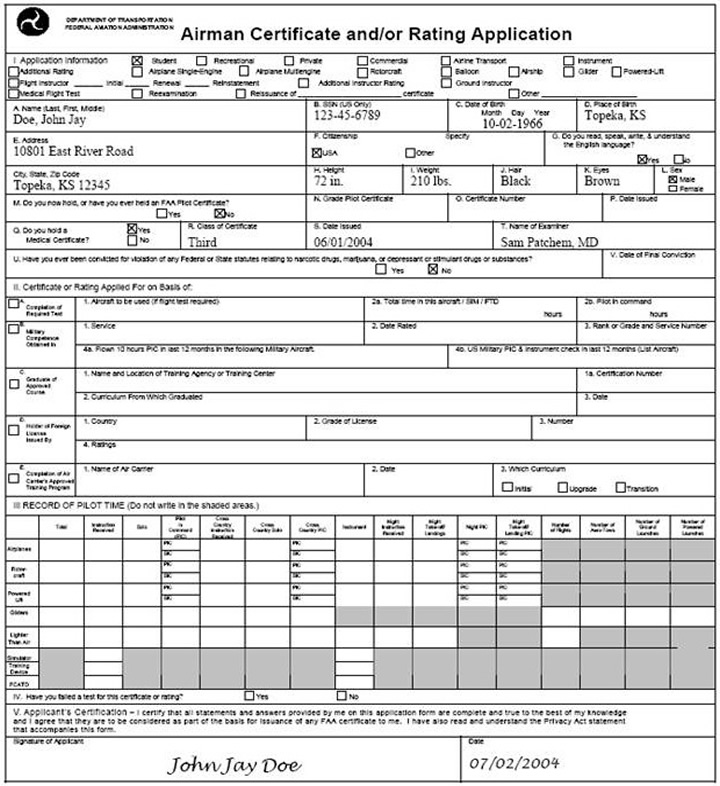
FAA PILOTS LICENSE REQUIREMENTS
(WHAT IS REQUIRED TO LEARN HOW TO FLY
FAA REQUIREMENTS FOR A PRIVATE PILOTS LICENSE)
|
|
 |
BECOME A PILOT
THE PROPER WAY TO GETTING YOUR PILOTS LICENSE
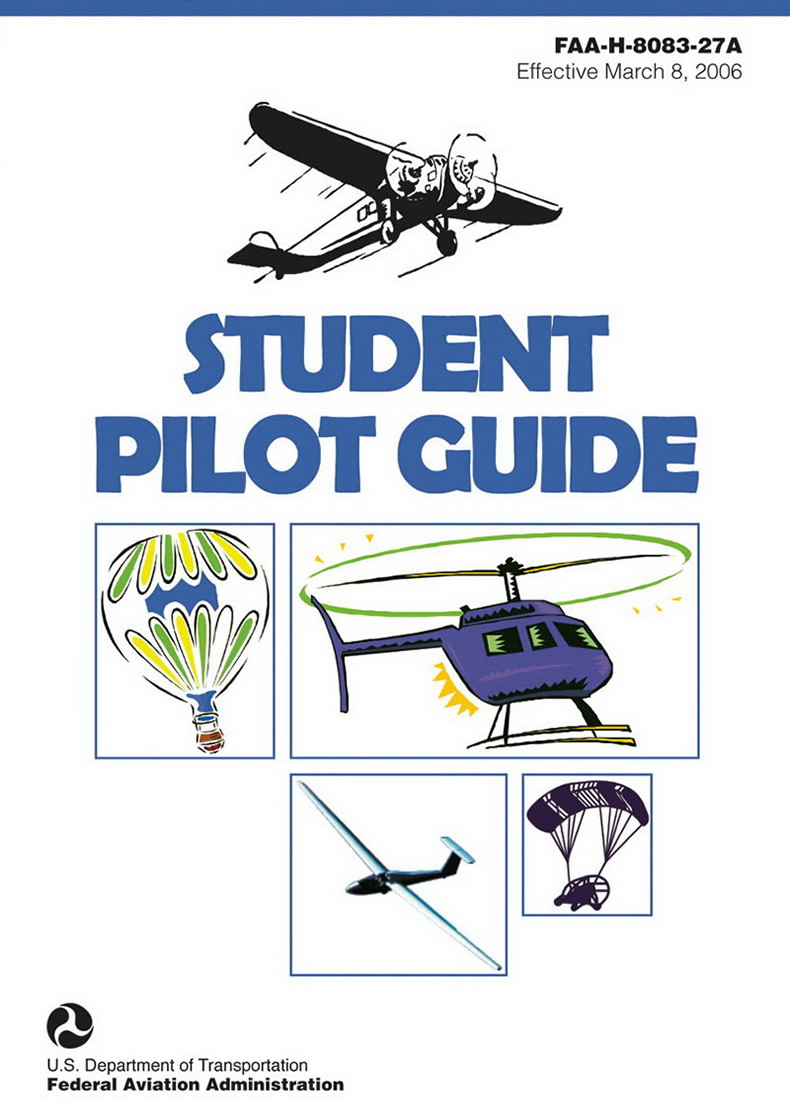
STUDENT PILOT FLIGHT GUIDE FROM THE FAA IN PDF FORMAT - DOWNLOAD OR VIEW HERE
What is the first step to becoming a pilot?
Decide what you want to fly. FAA’s rules for getting a pilot’s license (certificate) differ depending on the type of aircraft you fly. You can choose among airplanes, gyroplanes, helicopters, gliders, balloons, or airships. If you are interested in flying ultralight vehicles, you don’t need a pilot’s license.
You should also think about what type of flying you want to do. There are several different types of pilot’s licenses, from student pilot all the way up to airline transport pilot. The information below describes the eligibility, training, experience, and testing requirements for Student Pilots, Recreational Pilots and Private Pilots.
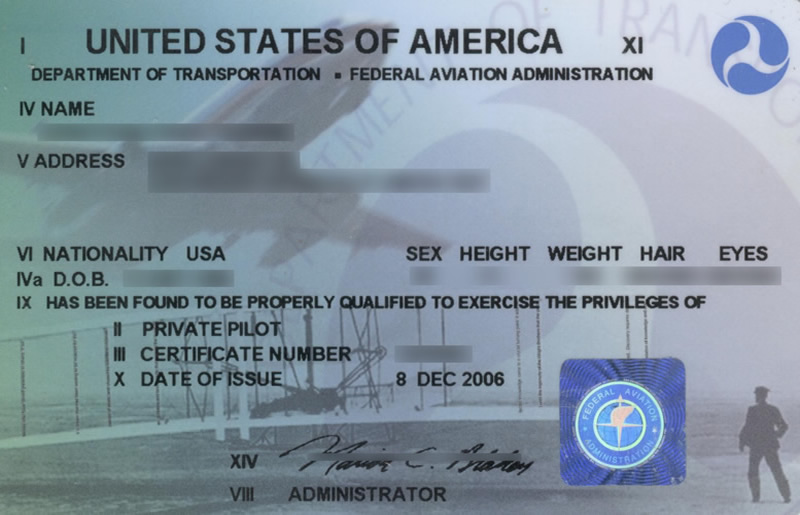
The requirements for being issued a private pilot license are governed by the
Federal Aviation Administration (FAA) of the U.S. Department of Transportation.
To get a private pilot's license, you must
- be at least 17 years
- have a current FAA third-class medical certificate
- log at least 40 hours of flight
- have at least 20 hours of flight with an instructor
- have at least 10 hours of solo flight
- pass the FAA Private Pilot Airmen Knowledge written test
- pass a FAA Private Pilot flight exam
Requirements regulating the licensing of private pilots are established by the Federal Aviation Administration of the U.S. Department of Transportation and set forth in Federal Aviation Regulation, Part 61.
Sec. 61.109 Airplane Rating: Aeronautical Experience
An applicant for a private pilot certificate with an airplane rating must have had at least a total of 40 hours of flight instruction and solo time which must include the following:
(a) Twenty hours of flight instruction from an authorized flight instructor, including at least--
- Three hours of cross country;
- Three hours of instrument flight training;
- Three hours at night, including 10 takeoffs and landings for applicants seeking night flying privileges; and
- Three hours in airplanes in preparation for the private pilot flight test within 60 days prior to that test.
An applicant who does not meet the night flying requirement in paragraph (a) of this section is issued a private pilot certificate bearing the limitation "Night flying prohibited." This limitation may be removed if the holder of the certificate shows that he has met the requirements of paragraph (a) of this section.
(b) Ten hours of solo flight time, including at least:
- Five hours of cross-country flights, each flight with a landing at a point more than 50 nautical miles from the original departure point. One flight must be of at least 150 nautical miles with landings at a minimum of three points, one of which is at least 50 nautical miles from the original departure point.
- Three solo takeoffs and landings to a full stop at an airport with an operating control tower.
Sec 61.103 Eligibility requirements: General.
To be eligible for a private pilot certificate, a person must--
- Be at least 17 years of age, except that a private pilot certificate with a free balloon or a glider rating only may be issued to a qualified applicant who is at least 16 years of age;
- Be able to read, speak, and understand the English language, or have such operating limitations placed on his pilot certificate as are necessary for the safe operation of aircraft, to be removed when he shows that he can read, speak, and understand the English language;
- Hold at least a current third-class medical certificate issued under Part 67 of this chapter, or, in the case of a glider or free balloon rating, certify that he has no known medical defect that makes him unable to pilot a glider or free balloon, as appropriate;
- Pass a written test on the subject areas on which instruction or home study is required by Sec. 61.105;
- Pass an oral and flight test on procedures and maneuvers selected by an FAA inspector or examiner to determine the applicant's competency in the flight operations on which instruction is required by the flight proficiency provisions of Sec. 61.107; and
- Comply with the sections of this part that apply to the rating he seeks.
Sec 61.105 Aeronautical Knowledge (Airplanes and rotorcraft Sec 61.105(a)
An applicant for a private pilot certificate must have logged ground instruction from an authorized instructor, or must present evidence showing that he has satisfactorily completed a course of instruction or home study in at least the following areas of aeronautical knowledge appropriate to the category of aircraft for which a rating is sought.
Airplanes and rotorcraft.
- The accident reporting requirements of the National Transportation Safety Board and the Federal Aviation Regulations applicable to private pilot privileges, limitations, and flight operations for airplanes or rotorcraft, as appropriate, the use of the "Airman's Information Manual," and FAA advisory circulars;
- VFR navigation using pilotage, dead reckoning, and radio aids;
- The recognition of critical weather situations from the ground and in flight, the procurement and use of aeronautical weather reports and forecasts;
- The safe and efficient operation of airplanes or rotorcraft, as appropriate, including high-density airport operations, collision avoidance precautions, and radio communication procedures;
- Basic aerodynamics and the principles of flight which apply to airplanes or rotorcraft, as appropriate; and
- Stall awareness, spin entry, spins, and spin recovery techniques for airplanes.
Sec 61.107 Flight Proficiency (Airplane Sec 61.107(a)
The applicant for a private pilot certificate must have logged instruction from an authorized flight instructor in at least the following pilot operations. In addition, his logbook must contain an endorsement by an authorized flight instructor who has found him competent to perform each of those operations safely as a private pilot.
In Airplanes.
-
Preflight operations, including weight and balance determination, line inspection, and airplane servicing.
-
Airport and traffic pattern operations, including operations at controlled airports, radio communications, and collision avoidance precautions.
-
Flight maneuvering by reference to ground objects.
-
Flight at slow airspeeds with realistic distractions, and the recognition of and recovery from stalls entered from straight flight and from turns.
-
Normal and crosswind takeoffs and landings.
-
Control and maneuvering an airplane solely by reference to instruments, including descents and climbs using radio aids or radar directives.
-
Cross-country flying, using pilotage, dead reckoning, and radio aids.
-
Maximum performance takeoffs and landings.
-
Night flying, including takeoffs, landings, and VFR navigation.
-
Emergency operations, including simulated aircraft and equipment malfunction.
|
UPDATE....
- How old do I have to be to take the recreational pilot or private pilot written test?
At least 15 years old. If you want to pilot a balloon or glider, you must be at least 14 years old. Before taking the knowledge test, you may have to show proof of age, such as a birth certificate.
- How should I prepare for the knowledge test?
You should study the materials identified by your flight instructor or included in a home-study course. For the recreational pilot test, the materials are based on section 61.97 of FAA's rules. For the private pilot test, the materials are based on section 61.105 of FAA's rules.
- What document or documents must I present before taking a knowledge test?
You have to present identification that includes your photograph, signature, and home address. Any one of the following:
A certificate of graduation from a pilot training course conducted by an FAA-approved pilot school, or a statement of accomplishment from the school certifying the satisfactory completion of the ground-school portion of such a course
A written statement from an FAA-certified ground or flight instructor, certifying that you have satisfactorily completed the required ground instruction
Logbook entries by an FAA-certified ground or flight instructor, certifying satisfactory completion of the required ground instruction
A certificate of graduation or statement of accomplishment from a ground school course conducted by an agency such as a high school, college, adult education program, the Civil Air Patrol, or an ROTC Flight Training Program.
A certificate of graduation from a home-study course developed by the aeronautical enterprise providing the study material.
If you can't provide any of the above items, you can have the home-study course you have completed reviewed by an FAA inspector to assure you are competent to take the desired knowledge test. Contact the local FAA Flight Standards District Office to get an appointment with an FAA inspector. The inspector will review your study material and may question you on some of the material. If you are found qualified to take the test, the inspector will issue FAA Form 8060-7, Airman's Authorization for Written Test. You must present this form when you take your knowledge examination.
If you have to take the test over again, you must present either the unsatisfactory AC Form 8080-2, Airman Written Test Report, or an airman computer test report (if the test was taken at an FAA-designated computer testing center).
- If I fail the knowledge test, is there any way to determine the areas in which I need additional work so I can study for a retest?
Yes. You will receive either AC Form 8080-2, Airman Written Test Report, or an airman computer test report (if the test was taken at an FAA-designated computer testing center). The test report will contain your test score and will also list the subject matter codes for the knowledge areas in which you were found deficient. An outline of the subject matter codes is located in the appendix of each written test book. You may refer to the appropriate written test book to determine the areas in which further study is needed.
- How long is a satisfactorily completed knowledge test valid?
A satisfactorily completed knowledge test expires two years from the day it was taken. If a practical test is not satisfactorily completed during that period, another knowledge test must be taken.
- Will my instructor review the areas in which the test report showed I was deficient?
Yes. Your instructor must review the areas in which you were deficient and must endorse the written test report or provide a written endorsement indicating this review has been completed.
- Types of Pilot Schools
Most airports have pilot training available, either by flying schools or individual flight instructors. A school will usually provide a wide variety of training aids, special facilities, and greater flexibility in scheduling.
A number of colleges and universities also provide pilot training as a part of their curricula. There are two types of schools. One is normally referred to as an "FAA-approved school" and the other as a "non-approved school." Enrollment in an FAA-approved school usually ensures a high quality of training. FAA-approved schools meet prescribed standards with respect to equipment, facilities, personnel, and curricula. However, many excellent pilot schools find it impractical to qualify for the FAA certification, and are referred to as non-approved schools.
One of the differences between FAA-approved schools and non-approved schools is that fewer flight hours are required to qualify for a pilot certificate in an FAA-approved school. The requirement for a private pilot certificate is 40 hours in a non-approved school, and 35 hours in an approved school. However, since most people require 60 to 75 hours of training, this difference may be insignificant for a private pilot certificate.
|
Learn To Fly Here - Flight Lessons And Schools - Get Your Pilots License
© AviationExplorer.com - The Website For Aviation Enthusiasts |
|